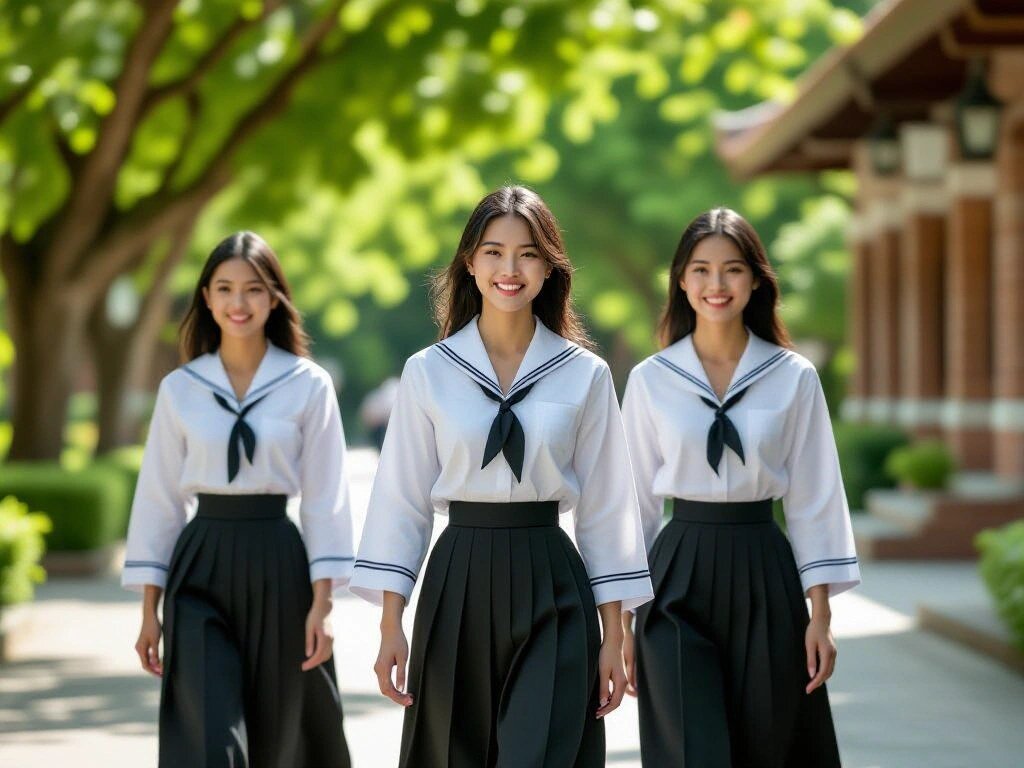
The image of a Thai university student is usually wrong on both ends. Foreigners either picture a stereotype from a tourist menu or a glossy fantasy from social media, neither of which has much to do with the actual lives of the women earning degrees at Chulalongkorn, Thammasat, Mahidol, Kasetsart, Khon Kaen, or Chiang Mai University right now. This is what their world actually looks like in 2026, with real numbers from current students and recent graduates posting on Reddit, Pantip, and X this year.
The Uniform Thing
Yes, they really wear them. Most undergraduates at Thai public universities wear uniforms four or five days a week. The standard look is a starched white blouse for women, black skirt to the knee, black flats or low heels, and a university belt buckle. Men wear a white shirt, black trousers, and a black tie or pin depending on faculty. Faculty colors and pins identify which department you belong to.
The strictness varies. Chulalongkorn enforces it most rigorously, with proctors who can stop a student in the hallway and send her home to change. Thammasat is the most relaxed and lets seniors wear polos and dark pants. International programs at any university are looser, with most students wearing business casual instead of full uniform. Casual Friday is a real thing on most campuses.
The uniform is not seen as oppressive. Talk to current students and most of them say they prefer it. It removes the daily question of what to wear, it equalizes class differences within the student body, and the white-and-black aesthetic is genuinely flattering. The famous photos of Thai university students in uniform that travel the world are not staged. They are just Tuesday morning on a Thai campus.
Where They Live
Most Thai students do not live in dormitories. On-campus dorms exist but rooms are limited and competitive, allocated by lottery or by need. The price is good (3,000 to 8,000 baht per month) but the conditions are basic. A current Reddit thread about Chulalongkorn dorms in 2025 had exchange students calling the on-campus accommodation "pretty bad" and recommending off-campus options instead.
The default is a "student room" within walking distance of campus. These are private studio rooms in low-rise apartment buildings, with their own bathroom and a small balcony. Furniture is included. Costs depend heavily on the city.
In Bangkok near Chulalongkorn, Thammasat (Pinklao or Rangsit campus), Mahidol (Salaya), and Kasetsart, expect 8,000 to 15,000 baht per month for a basic studio. Prices have crept up in 2025 and 2026 as Bangkok rents rose. A well-shared Reddit thread from July 2025 had a Thung Khru student paying 11,364 baht for her room with utilities adding another 1,500 to 2,000.
Outside Bangkok the numbers drop sharply. At Khon Kaen University, Chiang Mai University, or Mahasarakham, a student room runs 3,000 to 7,000 baht. A Chiang Mai University freshman thread from 2025 reported a clean studio with AC for 4,500 baht near campus. Regional university towns are still cheap to live in.
Many students from rural provinces commute home on weekends. The bus from Bangkok to Khon Kaen is around 400 baht. Going home keeps the family connection alive and lets them eat home cooking instead of campus food for two days.
The Daily Schedule
Class schedules vary by faculty but the typical Thai program runs 15 to 25 contact hours per week, distributed across mornings and early afternoons from roughly 8 AM to 4 PM. Heavy group work and projects fill the evenings. Engineering, medicine, and architecture students at top universities routinely report 8 to 12 hour days during exam periods.
International programs run lighter on contact hours but heavier on independent reading and group projects. Class size is smaller, English is the language of instruction, and grading tends to be harder than the equivalent Thai program. The trade-off is higher tuition, often three to five times the Thai-program rate.
The semester structure is split into two main terms (August through December and January through May) with a long summer break from March to June. Songkran in mid-April falls during the break, which is why most universities are quiet during the festival.
What It Costs to Be a Student
Real monthly costs based on student threads from 2025 and early 2026, grouped by campus location:
For a Bangkok student at Chulalongkorn, Thammasat, Mahidol, or Kasetsart, the basic monthly budget runs 18,000 to 36,000 baht all-in. Rent eats 8,000 to 15,000. Food another 6,000 to 10,000 if you mostly eat on campus and at street stalls. Transport (BTS plus the occasional taxi) is 1,000 to 4,000. Phone, internet, and utilities are another 1,500 to 2,000. Coffee, study cafes, occasional movies, and small social outings round it out at 2,000 to 5,000.
For a regional student at Khon Kaen University or Chiang Mai University, the same budget runs 10,000 to 22,000. Rent is half. Transport is mostly walking and a motorbike taxi here and there. Food is cheaper because the night markets and student stalls in those cities are still under inflation pressure that has hit Bangkok harder.
The money comes from family in almost every case. A common Bangkok allowance in 2025 and 2026 is 12,000 to 20,000 baht per month, with parents covering tuition separately. A Reddit thread from July 2025 had Thai alumni recalling 12,000 baht allowances ten years ago and current students saying their roommates from Chiang Mai get 20,000. Wealthier families send 25,000 or more. Students from poorer rural backgrounds get less and stretch it further by eating cheaply and staying with extended family in Bangkok on weekends.
Tuition itself ranges widely. Public university Thai programs run 15,000 to 50,000 baht per semester depending on faculty. Public university international programs are 60,000 to 150,000 per semester. Private universities like Bangkok University or ABAC run higher still. Engineering and medicine cost more than humanities at every tier.
Food Culture on Campus
Campus canteens at every major Thai university are excellent and cheap. A full meal of khao man gai (chicken rice), pad ka prao (basil pork), or som tam (papaya salad) runs 40 to 60 baht. Mahidol Salaya and Chulalongkorn both have legendary canteen scenes that draw students from off-campus. Vietnam pizza, fried chicken with sticky rice, and bowls of guay teow noodle soup all sit at 50 baht or under.
Daily food spend for a Bangkok student is typically 200 to 400 baht. An X post from a Thai student in April 2026 broke down a daily routine of two iced lattes (120 baht total) and two meals at 80 to 100 baht each, for a 370 baht per day average. That works out to roughly 11,000 baht per month, which matches what current students report.
Bubble tea, iced coffee, and ChaTraMue Thai tea are the constant background of Thai student life. Cafes near campus stay packed from morning until late evening with students working on laptops. The cafe-as-study-space culture is genuinely embedded.
Meet Thai University Women Directly
Every woman on Thai University Girls is a real student or recent graduate from a Thai university. ID-verified, active profiles, no agency middlemen. Browse who is online right now and message her directly.
Social Life and Clubs
Thai universities run dozens of student clubs (chumrum) covering sports, arts, music, language, volunteering, photography, gaming, and more. Joining a club is the standard entry point to social life, and most students belong to two or three. At Chulalongkorn, soccer is a major social event with stadium games against Thammasat that fill 50,000 seats. At regional universities, kradan (large freshman events) and concerts pull most of the campus.
The "freshy" culture (freshman week and ongoing freshman events) is heavier than its Western equivalent. New students are organized into groups, paired with senior mentors (called rao phi for big sister, phi chai for big brother), and integrated into faculty traditions. Some of this skirts the line between bonding and hazing, with senior students assigning small chores or having freshmen serve drinks. The hazing aspect is more reserved at the elite Bangkok universities and more intense at second-tier and regional schools.
Social outings for older students lean toward malls, board game cafes, restaurants with live music, concerts, and gym sessions. Bars and clubs exist but are not the default. A 2025 Reddit post from a fully Thai third-year student summarized normal weekend activity as "go to malls with friends, board game cafes, restaurants with live music, concerts, gaming, consume anime and manga, hit the gym." Bars happen, but mostly after a student starts university and gradually rather than freshman year.
This is the single biggest cultural difference from a Western university. Thai students do not live in a party-first culture. The party scene exists but it is not the center of social life, and a student who wants to opt out faces no social penalty for doing so.
Part-Time Work Is Uncommon
Most Thai students do not have part-time jobs. Family covers tuition and a monthly allowance, the expectation is that university is for studying, and the part-time labor market for students pays badly enough that the math rarely works. Tutoring English to younger students at 200 to 500 baht per hour is the most common gig for those who do work. Some students serve at family-owned shops or restaurants on weekends.
This is shifting at the edges. Students from middle-class families increasingly take freelance digital work (graphic design, social media, video editing) for pocket money. Internships in the third or fourth year are competitive, especially in finance, tech, and media, with some students reporting twenty or more applications before landing one.
The post-graduation job market is the genuine pressure point. Entry-level salaries in Bangkok start around 18,000 to 25,000 baht per month for non-prestigious fields and 25,000 to 35,000 for hot ones like programming or finance. AI replacing entry-level work is a real anxiety surfaced in current Thai student threads, the same conversation happening on every campus globally.
Dating on Campus
Campus dating is conservative compared to Western norms. The pace is slow, family approval matters early, and casual hookups are the exception rather than the rule. Couples form through mutual friends, club activities, group projects, or chat conversations on LINE that grow into something over weeks rather than nights.
Public displays of affection are limited. Holding hands is normal. Kissing in public is rare. Living together before a serious commitment is heavily frowned upon by most Thai families and almost never happens openly during undergraduate years, even when the practical reality is that the woman has her own room.
For a foreign student or a foreigner who wants to date a Thai university woman, the rules are simple. Learn at least basic Thai. Most Thai students at top universities speak some English but they speak it as a second language, and the women dating only in English are typically dek inter (international school graduates) or those who have lived abroad. They are a smaller and harder-to-reach pool. Learning Thai opens up everyone else.
One Reddit post from late 2025 from a foreign student on a Bangkok campus put it cleanly: "Now I have many Thai friends and I managed to have a sweet girlfriend too." The catch was that he had spent the previous year learning Thai actively, which is what made it possible.
Skip the Tourist Bar Scene Entirely
If you want to chat with educated Thai women without flying across the world to gamble on Tinder, MyAsianFriend.com is the platform built for it. Every woman is ID-verified. New accounts get free credits to start conversations. No subscriptions, no bots.
Family and Money
Thai daughters, especially the eldest, grow up understanding that they are responsible for their parents in the long term. Sending money home is not a foreign expectation imposed by marriage. It starts the moment a daughter has any income at all, and it usually starts before that with small contributions from her allowance.
For a current student, this often looks like a 1,000 to 2,000 baht monthly transfer to her mother for groceries or a sick grandparent. After graduation it grows to 3,000 to 8,000. By the time she is in her late twenties earning a professional salary in Bangkok, regular support of 5,000 to 15,000 baht per month is normal, even when her parents own their home and have other income.
This is not "gold digging" and it is not because she is poor. It is the structural reality of a country with no functioning state pension and a culture that places immense value on filial duty. A Thai woman who does not send money home is an outlier and is usually covering up an estranged family situation. Understanding this matters because resentment about it is the single most common landmine in foreign-Thai relationships.
What Is Genuinely Different from Western Universities
Hierarchy is real and structural. Junior students defer to seniors. Students defer to professors absolutely. Calling a professor by their first name, challenging them in class, or going over their head is socially impossible in a Thai program. International programs are looser but the underlying respect for hierarchy persists.
Family is part of the campus experience in a way it is not in the West. Parents visit on move-in day, drop off care packages, call regularly, and may show up unannounced. Students are expected to go home for major holidays and family events, and skipping them is a serious matter.
The pace of social life is calmer. Loud parties, drinking culture, and sexual openness all exist on Thai campuses but at a much smaller scale than in the United States or the UK. Most Thai students are happy with this. Most exchange students take six months to adjust to it.
The job market pressure starts later but hits harder. Through years one to three, the pressure is mostly about grades and family expectations. By year four it shifts to internships, networking, and the brutal reality of an entry-level Bangkok salary that does not stretch as far as it used to. The economic anxiety is identical to what is happening on Western campuses, just expressed differently.
The Bottom Line
Thai university life is more affordable, more communal, more conservative, and more family-centered than its Western equivalent. The students you see in those famous uniform photos are not a costume shop and they are not a fantasy. They are real women navigating real lives with real budgets, real career pressure, and real family obligations.
If you want to actually meet some of them, learn Thai if you have time. If you do not, use a platform built for the purpose. Thai University Girls features real students with verified profiles, and MyAsianFriend.com connects you to ID-verified Thai women across the country, including students and recent graduates. Both work. Both beat showing up cold and hoping.